In November 2025, I traveled to Kenya as part of a project with illuminAid. It wasn’t a vacation in the usual sense. I didn’t build my days around famous sites or bucket-list stops, and I’m glad I didn’t. The parts that stuck with me were smaller, more human, and harder to summarize. This is me trying anyway, mostly by tracing the things I noticed, the things that surprised me, and the thoughts that followed me home.
One of the first things I registered was how many white people I saw in Nairobi. The city is very diverse and integrated. That changed after traveling to western Kenya. There, we didn’t see any white people for days at a time.
What softened that awareness was how consistently warm people were. Everyone speaks English. Most signs are written in English. I shouldn’t have been surprised. Kenya was a British colony from 1920 to 1963, and you can still feel that history embedded in everyday life.
In Nairobi, English sometimes felt like the default language in public spaces and professional settings. For me, that meant I could move through the city with fewer friction points than I expected. The more comfortable I felt, the more I was aware that comfort had a history.
One afternoon at Lake Victoria, I sat with a cold drink alongside a long-abandoned pier that was once part of a ferry route from Kendu Bay to Kisumu. I learned it shut down after the British left.
Another day, I visited a tea farm run by a British family. It sat in an area that was once known as the “White Highlands.” The visit itself was interesting, but I couldn’t help but notice the contrast. The neighborhood around the farm carried a level of comfort and wealth that felt worlds away from parts of nearby Nairobi. The difference wasn’t subtle. It was the kind of contrast that makes you feel history operating in the present tense.
Outside the big-city frame, daily life also had its own physical realities that shaped everything. In the areas I visited, there were relatively few paved roads. Navigation was difficult. Without street names and addresses, “where something is” becomes more relational than geographic. It’s landmarks and turns and local knowledge.
Air conditioning was non-existent, even when the temperature made it seem like it should be a standard comfort.
That’s the part that kept pulling my thoughts back toward home. I met so many smart, hard-working people who were living with far fewer resources than what we take for granted in California. More than once, I caught myself thinking about how differently some of these lives might unfold if the same talent and drive were dropped into a context with better scaffolding and more access. The thought made me feel deeply lucky, and also unsettled. It’s hard to sit with how much is determined by where you happen to be born.
The trip also gave me a point of comparison with Ethiopia, where I’d spent time before. Kenya felt more accommodating to Westerners, largely because of how widespread English is. Nairobi’s professional life felt globally integrated in a way I hadn’t fully expected. Social settings felt a bit less integrated to me, even when people were friendly. In Ethiopia, people had seemed friendlier overall, though I know that’s a fragile conclusion. My exposure was limited, and a few days in any country can trick you into thinking you understand more than you do.
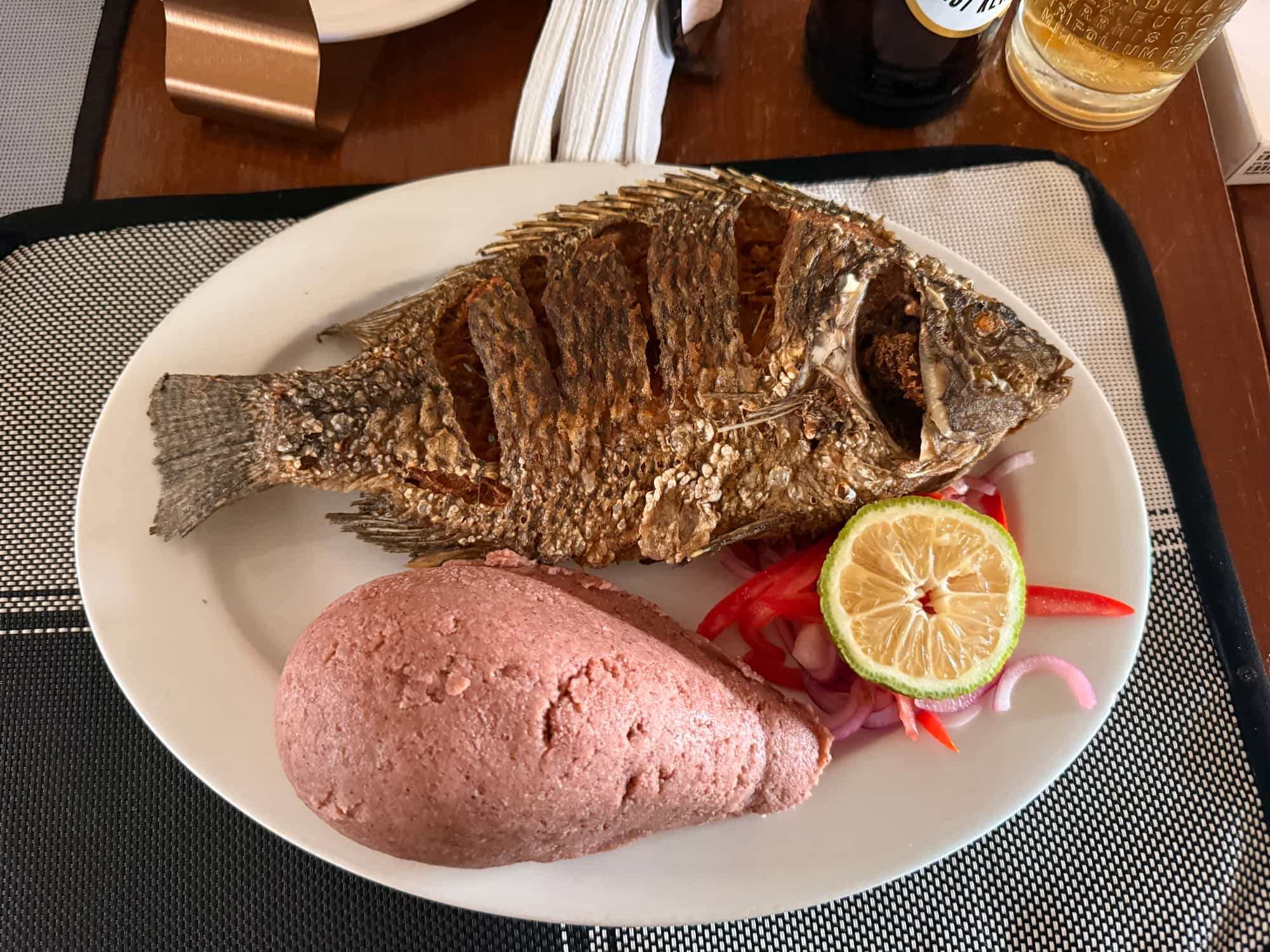
In the Homa Bay region, I ate a lot of tilapia, often with my hands. For a stretch I had it for dinner every day. Ugali came with every dinner: mostly white ugali made from corn, and once a brown ugali made from millet. I loved it. I’m determined to try making it at home.
I also had bananas that were savory, almost potato-like in flavor, but with that unmistakable banana texture.
Even though I didn’t do a safari on this trip, Kenya planted the seed. Seeing safari groups around made it feel close. The trip definitely made me want to go, and if I do, I might aim for Tanzania based on what I’ve been reading. Kenya would be incredible too, and I like the idea of returning with a different purpose and a little more time.
I didn’t come home with a checklist of sights. The most interesting part of this kind of travel, for me, is the chance to brush up against another way of living and let it rearrange your assumptions. Kenya did that. I came back with gratitude, questions about history and opportunity, and some very specific cravings that I’m going to have to solve in my own kitchen, starting with ugali and tilapia.